Bamboo flooring can be a smart material, but it is not automatically greener, harder, or easier to live with than every wood floor. The truth depends on how the bamboo was grown, how the plank was made, what adhesives and finishes were used, and whether the room can stay within the humidity range the floor needs.
A good bamboo floor should be judged like a building product, not a slogan. Look at construction type, finish quality, indoor-air certifications, warranty limits, installation method, subfloor condition, and daily wear. The best choice is not the product with the loudest eco claim; it is the one that fits the house and can be maintained after the first year.
A: No. Bamboo is a grass-based flooring product, so judge the construction and finish carefully.
A: It can be, but sustainability depends on sourcing, adhesives, finish, durability, shipping, and lifespan.
A: Strand-woven bamboo is often harder, but product quality and finish still matter.
A: Usually avoid wet rooms unless the manufacturer specifically approves the product and conditions.
A: Yes. Follow the product instructions for room conditions and timing.
A: It can be more stable, but the core, wear layer, installation, and warranty decide the result.
A: It can scratch, especially with pets, grit, furniture, weak finish, or poor maintenance.
A: Some can be lightly refinished, while thin wear layers or certain constructions may not allow it.
A: Compare bamboo with hardwood, vinyl, laminate, tile, and cork for the same room conditions.
A: Confirm room suitability, moisture limits, samples, finish, warranty, installation method, and extra material.
Bamboo Is a Grass, Not Hardwood
Bamboo is often sold beside hardwood flooring, but botanically it is a grass. That difference does not make it weak or strong by itself. The performance comes from the manufacturing process: how the stalks are cut, pressed, bonded, treated, finished, and turned into planks.
This is why bamboo flooring varies so much. One product may handle daily traffic well, while another dents, scratches, cups, or delaminates quickly. The label “bamboo” tells you the source material. It does not tell you enough about the finished floor.
Understand the Main Bamboo Types
Horizontal bamboo shows wider grain bands and a more obvious bamboo look. Vertical bamboo has narrower lines and a more uniform appearance. Strand-woven bamboo is made by compressing bamboo fibers with resin under high pressure, which usually creates a denser floor.
Each type has a different look and performance profile. Strand-woven bamboo is often marketed as the toughest option, but quality still depends on resin, pressing, milling, and finish. Horizontal and vertical products may look warmer or more natural, but they can be softer and more vulnerable to dents depending on the product.
Question Hardness Claims
Bamboo flooring ads often lean heavily on hardness numbers. Those numbers can be useful, but they do not describe the whole floor. A hard surface can still scratch. A dense plank can still chip. A product with a strong core can still have a finish that wears poorly.
Ask what the hardness test measured and compare products from reputable manufacturers. Look at real samples, warranty language, finish type, and user conditions. The floor that survives a showroom display may still struggle with grit, chair legs, pet claws, moisture, and poor installation.
Look Closely at the Finish
The finish is what daily life touches first. It protects against scratches, stains, cleaning, shoes, pet traffic, and furniture movement. A weak finish can make a hard bamboo plank look worn quickly, while a better finish can extend the floor’s useful life.
Ask whether the finish is aluminum-oxide, UV-cured, oil-based, matte, satin, or another system. Check whether touch-up products exist. A very glossy finish may show scratches and dust more clearly. A matte finish can hide small marks but may need careful cleaning so it does not look cloudy.
Think About Moisture Honestly
Bamboo is sensitive to moisture and humidity changes. It can swell, shrink, cup, gap, or distort when conditions move outside the manufacturer’s range. Kitchens, entries, basements, and humid climates require extra attention before bamboo is chosen.
Moisture concerns do not always rule bamboo out, but they do change the planning. Test concrete slabs when required, control indoor humidity, follow acclimation directions, and avoid installing bamboo where leaks, wet shoes, pet bowls, or damp subfloors are regular problems.
Do Not Skip Acclimation
Acclimation lets flooring adjust to the home before installation. Bamboo planks may need time in the space with normal temperature and humidity. The exact requirement depends on the product, packaging, installation method, and manufacturer instructions.
Skipping acclimation can lead to movement after the floor is installed. Gaps, cupping, buckling, and edge problems are expensive to fix because the flooring is already locked, nailed, or glued into place. A few patient days can prevent months of frustration.
Check the Subfloor First
Bamboo flooring needs a suitable subfloor. The surface should be flat, clean, dry, stable, and compatible with the chosen installation method. High spots, dips, old adhesive, loose panels, moisture, and deflection can all show up later as gaps, squeaks, uneven wear, or failed glue.
Do not treat bamboo as a cover-up for subfloor problems. A beautiful plank cannot fix movement underneath it. If the subfloor needs leveling, fastening, drying, or repair, handle that before opening the flooring boxes.
Compare Solid and Engineered Bamboo
Solid bamboo planks are made primarily from bamboo material through the plank thickness. Engineered bamboo uses a bamboo wear layer over a core. Engineered products may offer better dimensional stability in some situations, but the wear layer thickness affects future repair options.
Neither format is automatically better. Solid bamboo may be more repairable in some cases, but it may also be more sensitive to conditions. Engineered bamboo may be more stable, but thin wear layers limit sanding. Read the product details instead of assuming the format tells the whole story.
Understand Installation Methods
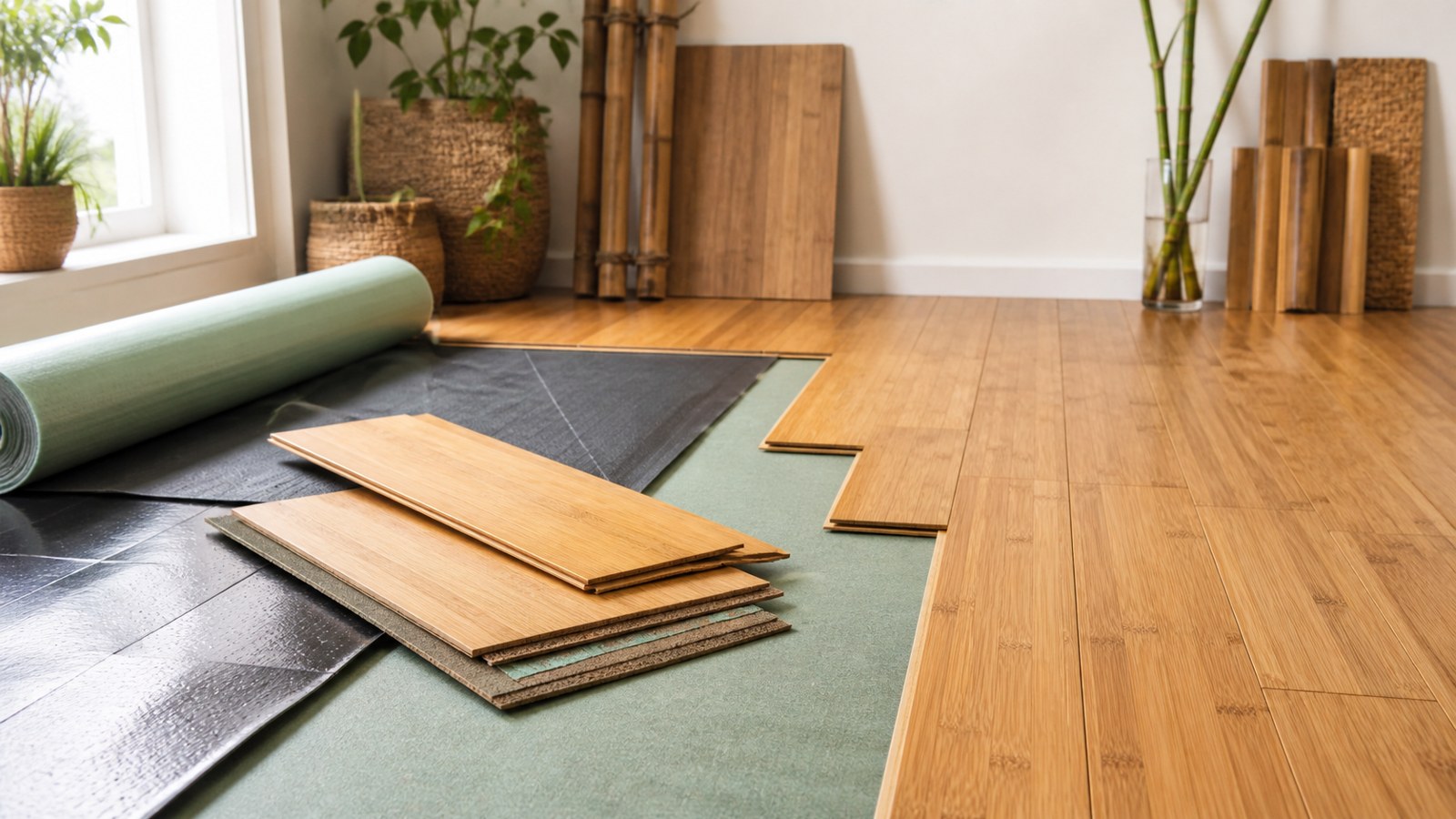
Bamboo flooring may be nailed, glued, floated, or clicked together depending on the product. Each method has different demands. Glue-down installation needs compatible adhesive and moisture control. Floating floors need expansion space and proper underlayment. Nail-down floors need the right subfloor and fasteners.
The installation method should match the room and the product. A floating floor in a large area may need transition planning. Glue-down floors over concrete require moisture testing. Nail-down floors require the right nailer or stapler and care to avoid tongue damage.
Do Not Treat Underlayment as an Afterthought
Floating bamboo floors often depend on underlayment for sound, minor subfloor separation, and moisture control. The wrong underlayment can make the floor feel hollow, trap moisture, void a warranty, or allow too much movement at the joints.
Read the flooring instructions before buying padding or vapor barriers. Concrete, wood subfloors, condos, bedrooms, and below-grade areas may have different requirements. A quiet sample in a store can feel very different across a whole room if the underlayment and subfloor are poorly matched.
Ask About Adhesives and Indoor Air
Bamboo flooring is manufactured with resins, binders, finishes, and sometimes adhesives. Indoor-air quality depends on the product, not just the bamboo plant. Look for credible emissions certifications and clear documentation from the manufacturer.
Vague claims like “natural” or “green” are not enough. Ask for formal certification, product data, and installation adhesive information. If the floor is being installed in a bedroom, nursery, office, or tightly sealed home, emissions and ventilation deserve real attention.
Separate Renewable From Sustainable
Bamboo grows quickly, which can make it renewable. Sustainability also includes harvesting practices, land use, manufacturing energy, adhesives, shipping distance, durability, repairability, and how long the product stays in service.
A floor that wears out quickly is not very sustainable even if the plant grows fast. A durable product with transparent sourcing, good indoor-air documentation, and a long service life is more convincing than a cheap floor that needs replacement after a few rough years.
Look at Color and Carbonization
Some bamboo flooring is carbonized to create a darker color. The process changes the appearance, but it may also affect hardness depending on the product. Darker bamboo should not be assumed to perform the same as a natural strand-woven plank.
Color also changes how wear appears. Dark floors can show dust, scratches, and pet hair more clearly. Very light floors can reveal stains or uneven aging. Bring samples into the home and look at them in daylight and evening light before deciding.
Consider Sunlight and Color Change
Like many flooring materials, bamboo can change color with sunlight and age. Rugs, furniture, and low-light areas may leave different exposure patterns over time. A floor that looks uniform on installation day may develop lighter or darker zones where sunlight hits strongest.
Ask the manufacturer what kind of color change is expected and whether the warranty excludes sunlight effects. Use window treatments in harsh sun and rotate rugs when possible. If the room has large south- or west-facing windows, sunlight behavior should be part of the buying decision.
Evaluate Scratch Resistance Realistically
Bamboo can be tough, but scratch-proof flooring does not exist. Sand, grit, pet claws, chair legs, rolling chairs, and dragged furniture can mark the finish. The question is not whether scratches can happen; it is how visible they will be and whether they can be repaired.
Use walk-off mats, felt pads, rugs in high-traffic areas, and good cleaning habits. Avoid abrasive cleaners and steam mops unless the manufacturer specifically allows them. A floor lasts longer when maintenance matches the finish.
Think About Pets and Kids
For homes with pets or children, strand-woven bamboo with a strong finish may be a candidate, but samples should be tested. Try dragging a chair foot across a sample, dropping a small object, or checking how the finish responds to everyday wear.
Also think about moisture. Pet bowls, accidents, wet shoes, and spills need quick cleanup. If the household needs a floor that tolerates standing water or frequent mopping, waterproof vinyl, tile, or another material may be a better fit.
Know the Repair Limits
Some bamboo floors can be refinished lightly, while others cannot be sanded safely because of thin wear layers, construction, or finish systems. Strand-woven products can be difficult to refinish because of density and finish hardness.
Ask before buying how scratches, gouges, stains, and worn traffic paths are repaired. If the answer is only “replace the damaged plank,” make sure extra material is purchased and stored. Future color matching can be difficult if the product line changes.
Plan Maintenance Before Installation
Maintenance should match the finish system. Some bamboo floors only need sweeping, vacuuming with a hard-floor setting, and a lightly damp mop approved by the manufacturer. Others may have stricter cleaner requirements or warnings against steam, wax, oil soaps, or abrasive pads.
Decide whether that routine fits the household. A floor that needs quick spill cleanup may not be ideal where wet shoes sit by the door every day. A finish that shows every footprint may annoy someone who wants a low-maintenance floor. Practical maintenance matters as much as the sample-board look.
Read the Warranty Carefully
Flooring warranties often sound stronger than they are. They may exclude moisture problems, improper acclimation, installation errors, pets, high heels, rolling chairs, commercial use, sunlight changes, or normal finish wear. The warranty is only useful if the home can meet the conditions.
Keep receipts, product labels, installation instructions, moisture readings, and photos. If a claim ever happens, documentation matters. A warranty that requires specific humidity control is not realistic unless the homeowner can actually maintain that range.
Compare Bamboo to Hardwood
Bamboo competes with hardwood on appearance, price, hardness, and environmental story. Hardwood may offer familiar refinishing options and a long track record. Bamboo may offer a modern look and strong performance in strand-woven products. Both can fail if installed in the wrong place.
Compare the exact products, not broad categories. A high-quality bamboo floor may outperform a soft, inexpensive hardwood. A well-made hardwood may outlast a bargain bamboo product with a weak finish. The decision should be product-specific.
Compare Bamboo to Vinyl and Laminate
Luxury vinyl and laminate often compete with bamboo because they can be less expensive, more moisture-tolerant, or easier to install. They may also feel less natural underfoot and have different repair limits. Bamboo sits in a middle ground between natural material appeal and manufactured flooring performance.
If moisture is the main concern, bamboo may not be the practical winner. If appearance, renewability, and a wood-like feel matter more, it may be worth considering. Room conditions should decide the comparison, not only the display-board look.
Choose Rooms Carefully
Bamboo can work well in living rooms, bedrooms, offices, hallways, and other dry spaces when humidity is controlled. It is riskier in full bathrooms, damp basements, laundry rooms, mudrooms, and areas with frequent standing water.
Entries and kitchens depend on household habits and product quality. If wet shoes, spills, pet bowls, or heavy traffic are common, use rugs and cleanup routines or choose a more forgiving floor. A beautiful material in the wrong room becomes a maintenance problem.
Sample Before Committing
Never choose bamboo from a small store display alone. Bring samples home and view them next to cabinets, trim, wall color, furniture, and natural light. Bamboo grain and color can read very differently depending on the room.
Order multiple samples if possible because variation matters. Put them under a chair, near a window, and beside other materials. The floor will cover a large surface, so the color and texture should feel right in the actual home, not only under showroom lighting.
Buy Enough Extra Flooring
Extra material is important with bamboo because future batches may not match the original color, plank profile, finish, or locking system. Keep attic, closet, or storage space for leftover planks after installation. They may be the easiest repair option years later.
Waste factor also matters during installation. Rooms with closets, angles, doorways, and transitions need more cuts. Ordering barely enough can turn one damaged board or layout change into a delay. A small reserve protects both the installation and future repairs.
Final Bamboo Flooring Review
Bamboo flooring is neither a miracle green product nor an automatic mistake. It can be durable, attractive, and responsible when the product is well made, properly certified, installed correctly, and used in rooms that stay dry and stable.
The overhyped version is the one sold only on fast growth, extreme hardness, or vague eco language. The better version is chosen by construction type, finish, moisture behavior, emissions documentation, repair options, warranty terms, and room fit. Judge the floor that way, and bamboo becomes a real option instead of a marketing promise.