Kitchen lighting upgrades work best when they solve the shadows first. A beautiful pendant cannot help much if the prep counter is dark, the sink feels gloomy, the pantry is hard to see, or the island light shines into everyone’s eyes. The best kitchen lighting makes cooking, cleaning, eating, and gathering easier.
A strong kitchen plan uses layers: general light for movement, task light for counters, accent light for depth, and decorative fixtures where they add style without blocking the work. The right mix can make an older kitchen feel cleaner and more expensive without changing the cabinets or counters.
Start with the places where hands work and people stand. Once those areas are lit well, the decorative choices become much easier to judge.
A: Fix the counter, sink, island, and cooking shadows before focusing on decoration.
A: Yes, because they put light directly on prep surfaces where ceiling fixtures often miss.
A: Use island length, fixture width, sight lines, and end clearance to decide.
A: Place them to serve counters, walkways, sink areas, and appliance zones rather than a plain ceiling grid.
A: Choose a consistent warm or neutral tone that keeps food, cabinets, counters, and nearby rooms natural.
A: Dimmers help because prep, cleanup, eating, hosting, and late-night use need different brightness.
A: Use diffused under-cabinet lighting, shielded bulbs, and fixture angles that avoid direct reflection.
A: Often yes, because storage zones need clear light only when doors or shelves are being used.
A: Mark work zones, fixture boxes, switch groups, cabinet lighting routes, and appliance locations early.
A: Call for new circuits, moved boxes, cabinet-light drivers, dimmer issues, wet locations, or uncertain wiring.
Find the Shadows First
Before buying fixtures, turn on the current lights at night and look for shadows. Stand at the sink, stove, island, coffee station, pantry, and main prep counter. Notice where your body blocks ceiling light and where cabinets create dark zones.
These shadows show where the upgrade should begin. A kitchen may not need more light everywhere; it may need light in the exact places where work happens. Adding brightness to the middle of the room will not fix a counter hidden under upper cabinets.
Take photos from normal working positions. Photos often reveal glare, dark corners, and uneven color better than memory does.
Add Under-Cabinet Lighting
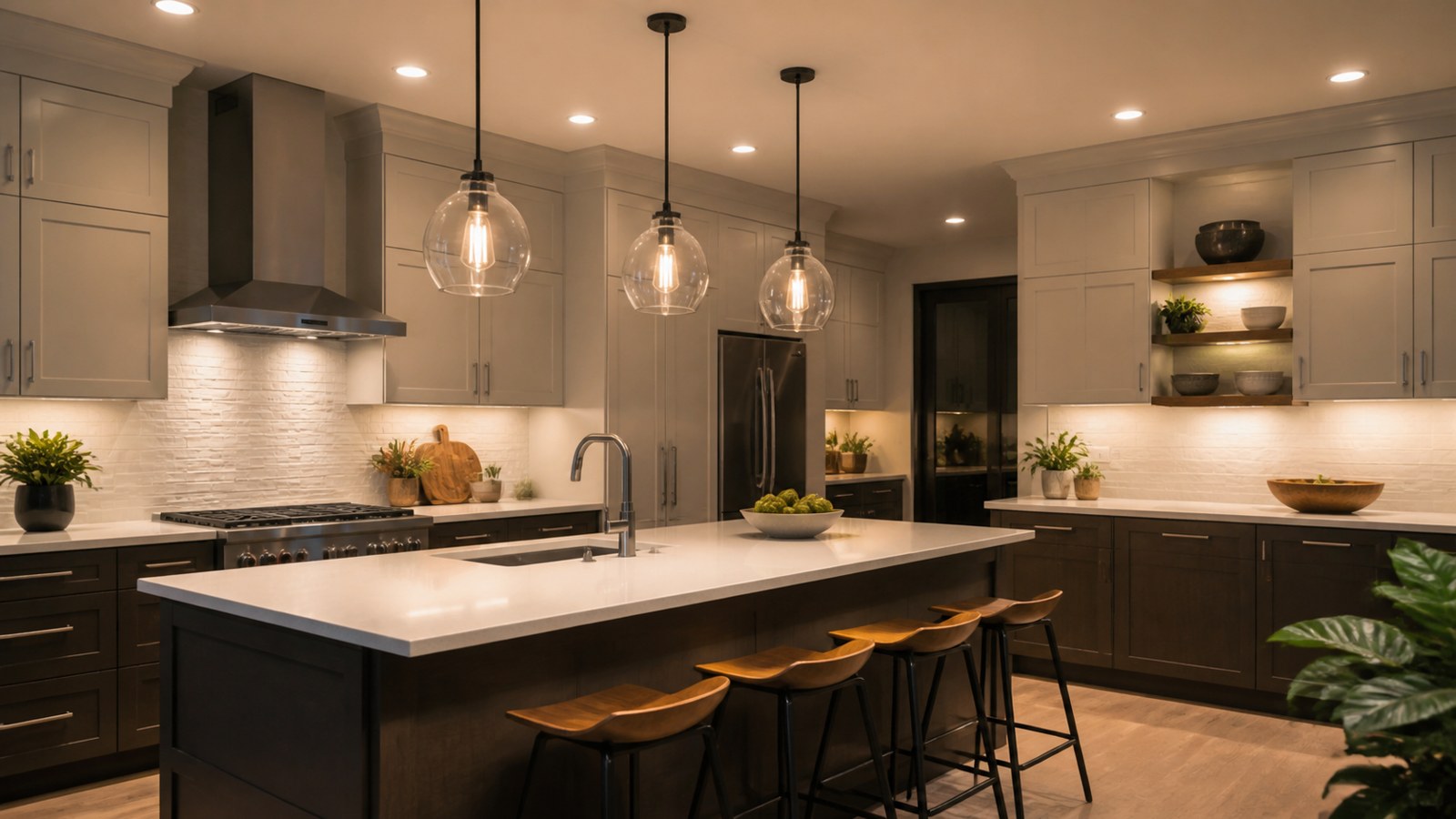
Under-cabinet lighting is one of the most useful kitchen upgrades because it puts light directly on the countertop. It helps with chopping, measuring, reading labels, cleaning, and seeing the backsplash. It also makes the kitchen feel warmer in the evening.
LED strips, light bars, and puck lights can all work, but continuous strips or well-spaced bars usually give more even light. Place the light toward the front of the cabinet so it reaches the work surface instead of only washing the backsplash.
Use diffusers where possible. Bare LED dots can reflect in glossy counters and create distracting glare.
Use Pendants With Purpose
Pendants over an island can define the kitchen and add style, but they need correct scale, height, and spacing. Fixtures that are too low block sightlines. Fixtures that are too small can look temporary. Fixtures that are too bright can glare into faces.
Choose pendants based on island length, ceiling height, seating, and the amount of other light in the room. Two larger pendants may look better than three tiny ones, while a long linear fixture may suit a narrow island.
Pendants should support the island’s job. If the island is used for prep, choose fixtures that provide useful downward light. If it is mostly for seating, softer light may be better.
Improve Sink Lighting
The sink is used constantly, and it often ends up poorly lit. A recessed light, pendant, sconce, or well-placed ceiling fixture can make washing dishes and cleaning vegetables easier. If the sink is under a window, it still needs light after dark.
Place sink lighting so it does not cast the user’s head and shoulders onto the basin. A light directly behind the person can make the work area darker, not brighter.
Use a fixture that suits moisture and cleaning. The sink area can see steam, splashes, and grease depending on the kitchen layout.
Layer Recessed Lights Carefully
Recessed lights can provide useful general light, but they are often overused or placed in a grid that ignores the counters. A kitchen does not become better just because the ceiling has more cans.
Place recessed lights to support walkways, cabinet fronts, counters, and open areas. Avoid putting every fixture directly behind the person working at the counter. Good placement reduces shadows instead of creating them.
Use consistent trim style and bulb color. A ceiling full of mismatched recessed lights can make the kitchen feel patched together.
Light the Pantry and Storage Zones
Pantries, appliance garages, deep cabinets, and open shelves often need their own light. A dark pantry wastes time and makes ingredients harder to find. Motion lighting can be useful if the door or location makes switching awkward.
For walk-in pantries, use bright, even light with good color quality. For cabinet interiors, low-profile LED strips or puck lights may help. Make sure products are suitable for the location and do not overheat enclosed spaces.
Storage lighting should be practical first. It does not need to be dramatic; it needs to make the contents visible.
Use Toe-Kick and Low Lighting Sparingly
Toe-kick lighting can make a kitchen feel polished and provide soft nighttime guidance. It works best when it is subtle. Overly bright toe-kick lights can make the room feel like a showroom rather than a home.
Low lighting is useful for late-night water, snacks, pet care, or moving through an open-plan space without turning on the main lights. Put it on a dimmer, motion sensor, or separate control when possible.
Keep the color warm and gentle. Night lighting should guide movement, not wake the whole room.
Choose Bulb Color Consistently
Kitchens need clear light, but clear does not have to mean cold. Warm-neutral bulbs often work well because they keep food and finishes appealing while still feeling bright enough for tasks.
Use the same or compatible color temperature across under-cabinet lights, pendants, recessed lights, and lamps. Mixed bulb colors can make cabinets look different from one wall to another and make the space feel unfinished.
Color rendering is important. Poor-quality bulbs can make food, counters, paint, and skin tones look dull or strange.
Put Key Layers on Dimmers
Dimmers let the kitchen shift from work mode to evening mode. Bright light helps with prep and cleanup. Lower light works for eating, conversation, and late-night use. Without dimmers, a kitchen often feels either too dark or too harsh.
Check dimmer compatibility with LED fixtures and bulbs. Flicker, buzzing, and poor low-end dimming are common when the dimmer and light source are not matched.
Separate layers where possible. Island pendants, under-cabinet lights, recessed lights, and accent lighting should not always have to turn on together.
Use Accent Lighting for Depth
Accent lighting can make a kitchen feel more finished. It might highlight open shelves, glass-front cabinets, a range wall, art, a coffee bar, or a textured backsplash. Accent light is not the main work light; it gives the room dimension.
Use restraint. Too many accent lights can make the kitchen feel busy. Choose one or two areas that deserve attention and let the rest of the lighting stay practical.
Accent lighting works best when the task layers are already handled. It should be the polish, not the fix for a dark counter.
Consider Lamps in Eat-In Kitchens
If the kitchen has a breakfast nook, sideboard, desk, or open shelf, a small lamp can soften the room. Lamps add warmth that ceiling and task lights sometimes cannot provide. They are especially useful in open-concept spaces where the kitchen needs to feel comfortable after dinner.
Choose lamps that are safe for the location. Keep cords away from prep zones, water, and heat. Use bulbs that match the room’s overall color temperature.
A lamp will not replace task lighting, but it can make the kitchen feel more like a living space.
Avoid Glare on Counters and Backsplashes
Glossy counters, polished stone, glass tile, stainless appliances, and shiny cabinet finishes can bounce light into the eyes. More brightness can make glare worse if the fixture is exposed or aimed poorly.
Use diffused fixtures, frosted lenses, careful aiming, and dimming to control reflections. Check the view from seating, standing prep positions, and nearby rooms.
Glare can make an expensive kitchen feel uncomfortable. Soft, well-placed light usually looks more upscale than harsh brightness.
Plan Lighting Before a Remodel
If the kitchen is being remodeled, lighting should be planned before cabinets, tile, and drywall are finalized. Cabinet layout affects under-cabinet wiring. Island size affects pendant placement. Ceiling joists can affect recessed light locations.
Mark fixture locations on the plan and think through switches before walls close. Moving a light after backsplash tile or finished ceilings are installed can be expensive.
Keep lighting specifications with the project notes: fixture model, bulb type, color temperature, dimmer model, and transformer or driver information when used.
Size Fixtures to the Kitchen
Scale can make or break a kitchen lighting upgrade. A tiny pendant over a large island looks lost. A bulky fixture in a low-ceiling kitchen can crowd the room. The fixture should relate to the island, table, sink, or work zone it serves.
Check height and sightlines before buying. People should be able to see across the island, open cabinets, and move around without feeling like the fixture is in the way. Cardboard mockups or painter’s tape can help preview size.
Style matters, but proportion matters first. A simple fixture at the right scale often looks better than a trendy fixture that fights the room.
Light Glass Cabinets and Open Shelves
Glass cabinets and open shelves can look flat without light. Small LED strips or puck lights can highlight dishes, glassware, cookbooks, or decorative pieces. This adds depth and helps the kitchen feel custom.
Keep the light soft and even. Bright cabinet lighting can create glare through glass doors or make shelves look cluttered. The goal is a gentle glow, not a display case unless the kitchen is designed that way.
Hide wires and drivers carefully. Visible cords can ruin the clean effect faster than the lights improve it.
Group Switches by Real Use
Kitchen switches should match how the room is used. Prep lighting, island lighting, general lighting, pantry lighting, and accent lighting may need separate control. If everything turns on together, the room loses flexibility.
Think through morning coffee, dinner prep, cleanup, homework at the island, and late-night snacks. Each routine may need a different lighting combination. Group switches and dimmers so those combinations are easy.
Labeling can help during the first few weeks after a remodel. If guests or family members cannot figure out the lights, the control plan is too complicated.
Upgrade Bulbs Before Replacing Fixtures
Sometimes the fastest kitchen lighting upgrade is a better bulb. Old bulbs may be too dim, too cool, too yellow, or inconsistent from fixture to fixture. Replacing mismatched bulbs can make the kitchen feel cleaner immediately.
Check lumen output, color temperature, color rendering, beam angle, and dimmer compatibility. A fixture that seems outdated may perform much better with the correct bulb.
This is also a low-risk way to test what the room needs before committing to new fixtures or wiring.
Avoid Common Kitchen Lighting Mistakes
The biggest mistake is choosing style before placement. A beautiful pendant that creates glare or leaves the counter dark is still the wrong light. Another mistake is relying on recessed lights alone, which can leave task surfaces in shadow.
Other common problems include mixed bulb colors, under-cabinet lights mounted too far back, pendants hung too low, non-dimmable LEDs on dimmers, and accent lighting added before task lighting is solved.
Good kitchen lighting should make the room easier to use every day. If a fixture only looks good when the kitchen is empty, it is not doing enough.
Coordinate With Nearby Rooms
Open-concept kitchens need to work with the rooms around them. Pendant finishes, bulb color, dimming level, and fixture style should relate to dining and living areas without making every fixture match exactly.
Think about the view from the sofa, dining table, and entry. A kitchen can be bright for prep while still dimming down enough to feel comfortable from nearby seating. This is one reason separate controls matter.
When kitchen lighting coordinates with the adjacent rooms, the whole open space feels calmer and more expensive.
Final Kitchen Lighting Review
The best kitchen lighting upgrades start with function. Light the counters, sink, island, pantry, and walking paths before focusing on decorative fixtures. Then use pendants, accent lighting, lamps, and dimmers to make the room feel finished.
A kitchen feels instantly better when shadows disappear, glare is controlled, bulb color is consistent, and each layer has a clear job. Good lighting can make the same cabinets and counters feel cleaner, warmer, and more intentional.